Quite recently, author Polly Courtney dropped her publisher, Harper Collins, because she felt that her work was being marketed wrong, and that the cover of her latest book was too racy and would not attract her target audience. She’s adamant that she’s not writing ‘chick lit’ and she would like to be taken more seriously. She has decided to go down the indie route… and fair play to Polly! See the full story here: http://www.channel4.com/news/does-the-chick-lit-label-dumb-down-womens-fiction
 The story caught my attention for a personal reason, and these are my personal reflections on the subject. While Polly is trying to distance herself from chick lit, I’ve been completely embracing the concept for my little indie marketing campaign of my novel, Sophie’s Turn. I don’t consider myself dumb, and I do love chick lit. Am I missing something here? I have no insight into Polly’s history with HarperCollins, nor am I questioning her decision or her motivations. I am not writing to discuss her actions or attack her views. But the story did get me thinking… about the merits of chick lit.
Why should ‘chick lit’ be a bad thing? Or, for that matter, a ‘dumb’ thing? ‘Trash’? I haven’t looked up any definitions (although I am sure they abound) but to me, ‘chick lit’ has always been short-hand for contemporary romantic comedy that is commercial by its very nature. But that’s quite a mouthful, and the logical acronym (CRCCbV…?) isn’t terribly catchy either. So ‘chick lit’ is as good a label as any, and it is just that to me: a label. Not a worthiness judgement, but a label that signals to the reader, “here is a fun book that is lighthearted and entertaining.”
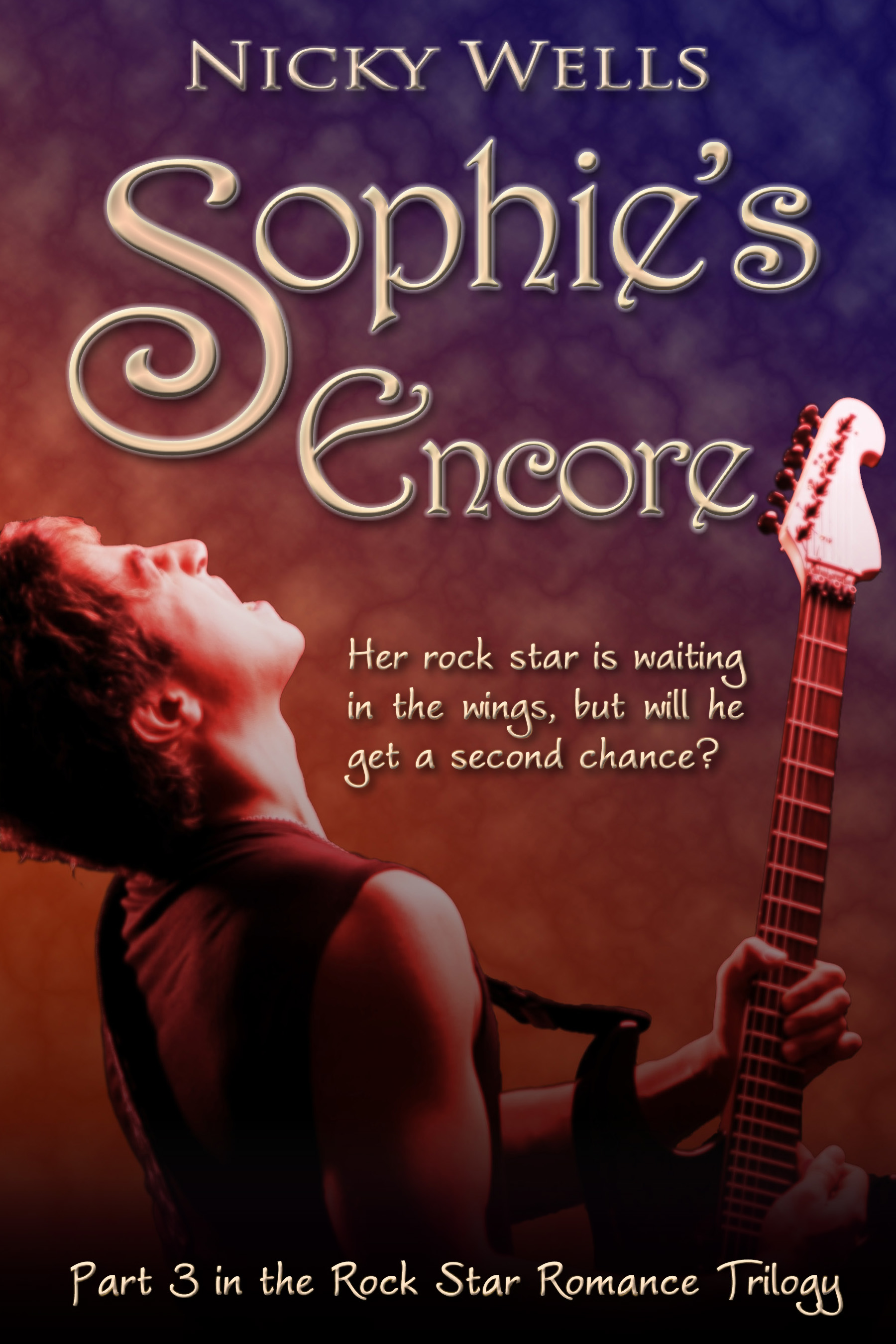
The unspoken deal between chick lit author and chick lit reader is that there has to be a happy ending because chick lit offers an escape from day-to-day routines and chores. The idea is that the reader walks away happy, buoyed and cheered. I view chick lit authors as my generation’s ‘new romantics’ (and don’t they always get a lot of grief?!?) Undoubtedly there are certain marketing strategies typically associated with chick lit: lots of pastel colours, a bit of glitz, a bit of glamour, stylised drawings (often involving flowers or butterflies). In fact, in designing the cover for Sophie’s Turn, I deployed these pointers to make the cover appealing to my audience (pink background, lilac writing, picture featuring a flower and a butterfly). So what?
In essence, chick lit to me is light, happy, pink, fluffy, and with an obligatory happy ending. Does that make it any less worthy? Chick lit doesn’t look at heavy-duty issues worthy of the label ‘literary fiction’; it doesn’t grapple with politics, economics or ecology. Chick lit authors aren’t likely to win the Booker prize any time soon. But that doesn’t by default mean that chick lit is ‘dumb’, or devoid of content or meaning. On the contrary, chick lit considers the very root of human life: relationships. Happy ones, and unhappy ones. Chick lit heroines are forever looking for love, losing love, betraying love, cheating for love, fighting for love, despairing of ever finding love. Increasingly, chick lit heroines are also moving on in the relationship cycle; having found Mr. Right, they would like to start a family. It turns out that some can’t get pregnant, some miscarry. Big issues are being tackled here! And then they move on into parenthood: the joys of being up all night with small children, changing nappies, feeling exhausted and weary and not in the slightest interested in S.E.X. while husband is cheerily demanding a quick return to normality… the challenges of teenagers and older children going off the rails, or starting their relationship cycles… More big issues being tackled here. In fact, one might argue that chick lit, through its very nature, offers a kind of ongoing social commentary on our times.
I’d say that makes chick lit quite inspirational. Consider the fact that the heroines usually get their happy ending; they may be bumbling or dipsy, but they get there in the end. And the underlying message to the reader is: so will you! Well then, what’s not to like? Don’t we all deserve a little TLC for the soul sometimes?
And all of this is a prelude for me to say: I am proud to be a ‘chick lit’ author, and I greatly enjoy reading chick lit myself. I don’t think that in so doing, I succumb to any kind of sexism by way of marketing; it’s perhaps more that I respond to type. So perhaps it boils down to personal choice. And that’s just fine by me… 🙂
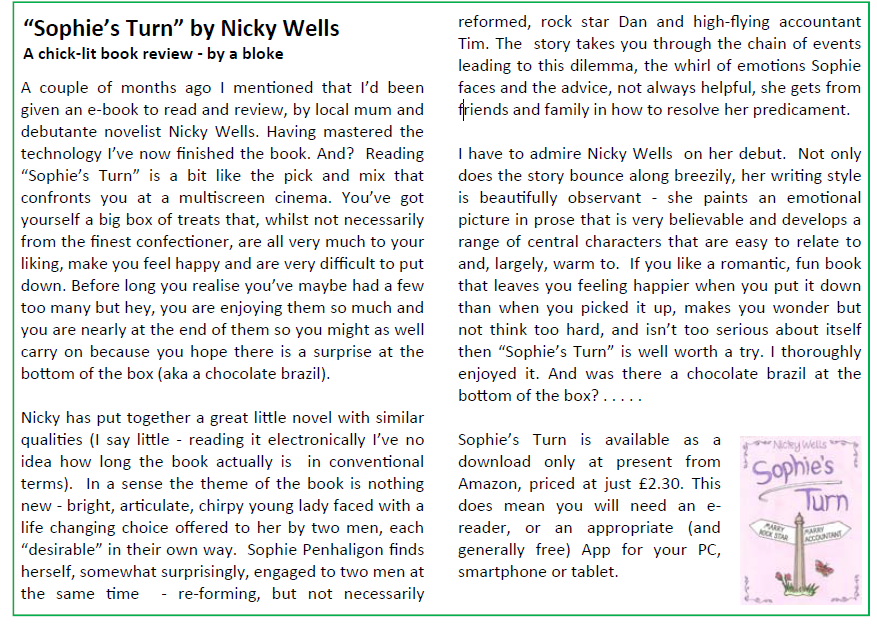
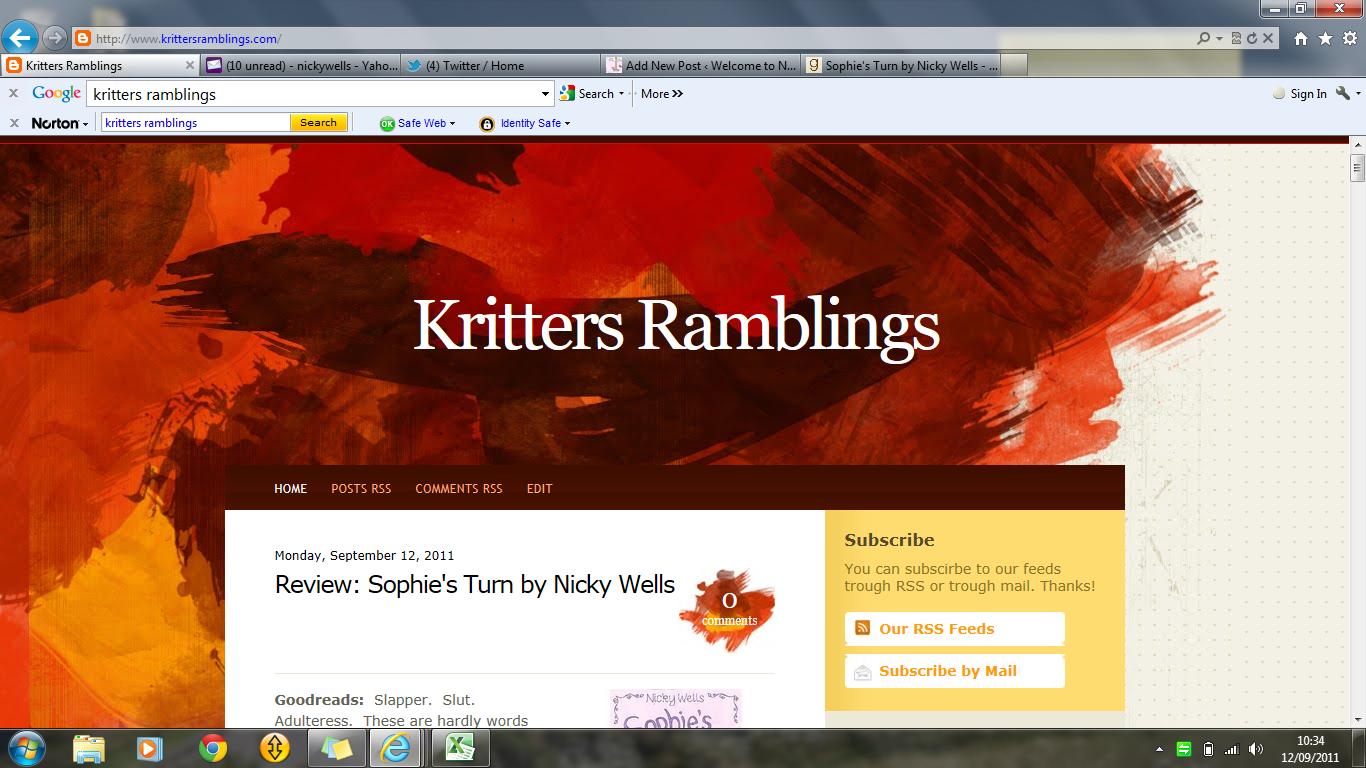
 Review number two for this week, hooray! Samantha Robey over at ChickLitPlus has taken the time to read and review my lovely rock star romance, Sophie’s Turn. Samantha says that Nicky Wells (well, yes, that’s me!!) “spins her story with a delicate hand that will have readers cheering Sophie on throughout the entire book.” Needless to say, I’m bowled over by this assessment and delighted at the 4 1/2 stars Samantha awarded to Sophie’s Turn. You can read the full review here.










 Nicky Wells: Love & Thrills